 Reactiva
A stroke (also known as a cerebrovascular accident, CVA, or "brain attack" in common language) occurs when the blood supply to a part of the brain is abruptly interrupted. Neurons require a constant supply of oxygen and glucose through the blood: when this supply fails, even for a few minutes, the nerve cells in the affected area begin to suffer damage.
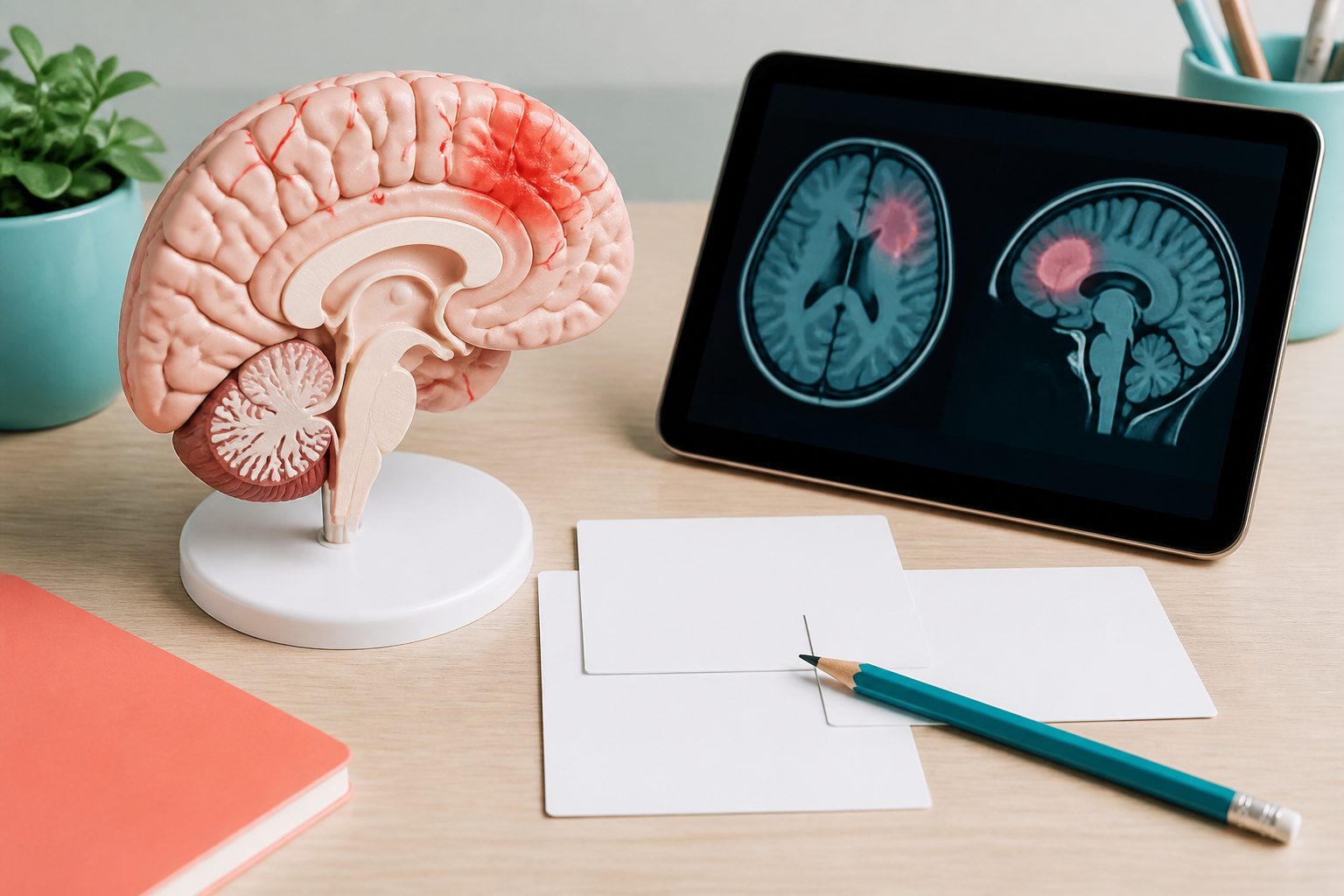
It is a medical emergency in the most literal sense of the word: the sooner action is taken, the less brain tissue is lost. Therefore, understanding what it is and how to recognize it can make a real difference.
The Two Main Types of Stroke
Not all strokes are the same — in fact, urgent treatment completely depends on identifying which type it is:
- Ischemic Stroke (the most common, about 85% of cases): an artery that supplies blood to the brain becomes blocked, usually by a clot. It’s like a "traffic jam" that cuts off the supply to the area dependent on that artery.
- Hemorrhagic Stroke: an artery ruptures and bleeds inside or around the brain. It is less common but tends to be more severe because, in addition to the lack of blood flow, the accumulated blood puts pressure on the surrounding brain tissue.
Distinguishing one from the other requires imaging tests (such as a CT scan) in the hospital — it is not something that can be determined solely by symptoms, and urgent treatment is different for each type. Hence, the importance of going to the emergency room immediately when a stroke is suspected, without waiting to see if "it will go away on its own."
Warning Signs: The FAST Rule
There is a simple way to remember the most common symptoms, widely used in public health campaigns because it is easy to recall under pressure: FAST.
- F — Face: Is one side of the face drooping or not moving well when smiling?
- A — Arms: When raising both arms, does one of them drop or cannot be held up?
- S — Speech: Does the speech sound slurred, confused, or does the person struggle to find words?
- T — Time: If any of these signs appear, it’s time to call emergency services. Every minute counts.
Other possible symptoms, which may appear alone or in combination: sudden loss of vision (in one or both eyes), intense dizziness or loss of balance without a clear cause, and a very strong and sudden headache that feels different from usual.
An important note: stroke symptoms almost always appear suddenly, not progressing over days. This abruptness is itself a warning sign.
Why Cognitive Rehabilitation Matters After a Stroke
Once the acute phase in the hospital is over, a different but equally important stage begins: recovery. Depending on which area of the brain has been affected, a stroke can leave very varied consequences — not only physical (weakness on one side of the body, difficulty walking) but also cognitive: memory problems, difficulty maintaining attention, slowness in processing information, changes in language (such as aphasia), or difficulties in planning and organizing daily tasks.
The brain has a remarkable ability to reorganize itself after an injury — known as neuroplasticity — and this is where cognitive rehabilitation comes in: through structured and consistent exercise and stimulation, it is possible for other neural networks to "take over" some of the damaged functions, or for the person to develop strategies that compensate for specific difficulties.
Therefore, after a stroke, cognitive work (memory, attention, language, executive functions) often goes hand in hand with physical rehabilitation and frequently continues for months. Consistency and regular practice — such as that offered by Reactiva+ with its daily challenges — are central to this process, always accompanied by the guidance of the professional team caring for each individual.
An Important Note
This article is for informational and educational purposes only. It does not replace a medical assessment nor intends to provide advice on any specific case. If there is any suspicion of a stroke, the recommendation is always the same: act quickly and contact emergency services.
A stroke (or "cerebral hemorrhage") happens when blood does not reach a part of the brain well. Neurons need constant oxygen. If they lack it, even for a few minutes, they start to get damaged.
It is a medical emergency. The sooner you act, the less damage remains.
The two types
- Ischemic (the most common): an artery gets blocked, usually by a clot.
- Hemorrhagic: an artery breaks and bleeds inside the brain.
How to recognize it: the FAST rule
- F (face): one side of the face droops.
- A (arms): one arm does not hold up when raised.
- S (speech): speech is confused or slurred.
- T (time): if you see this, call emergency services. Every minute counts.
Why rehabilitation matters
After the acute phase in the hospital, recovery begins. A stroke can cause memory, attention, language, or planning problems, as well as physical issues.
The brain can reorganize over time and with practice — this is called neuroplasticity. That is why cognitive training, consistently, is an important part of recovery.
Note
This text is for information only and does not replace medical evaluation. If you suspect a stroke, call emergency services without waiting.
This content is educational and does not replace assessment, diagnosis or supervision by a healthcare professional.