 Reactiva
The brain does not operate as a collection of independent drawers. To read, speak, remember, or move, many areas work together at the same time.
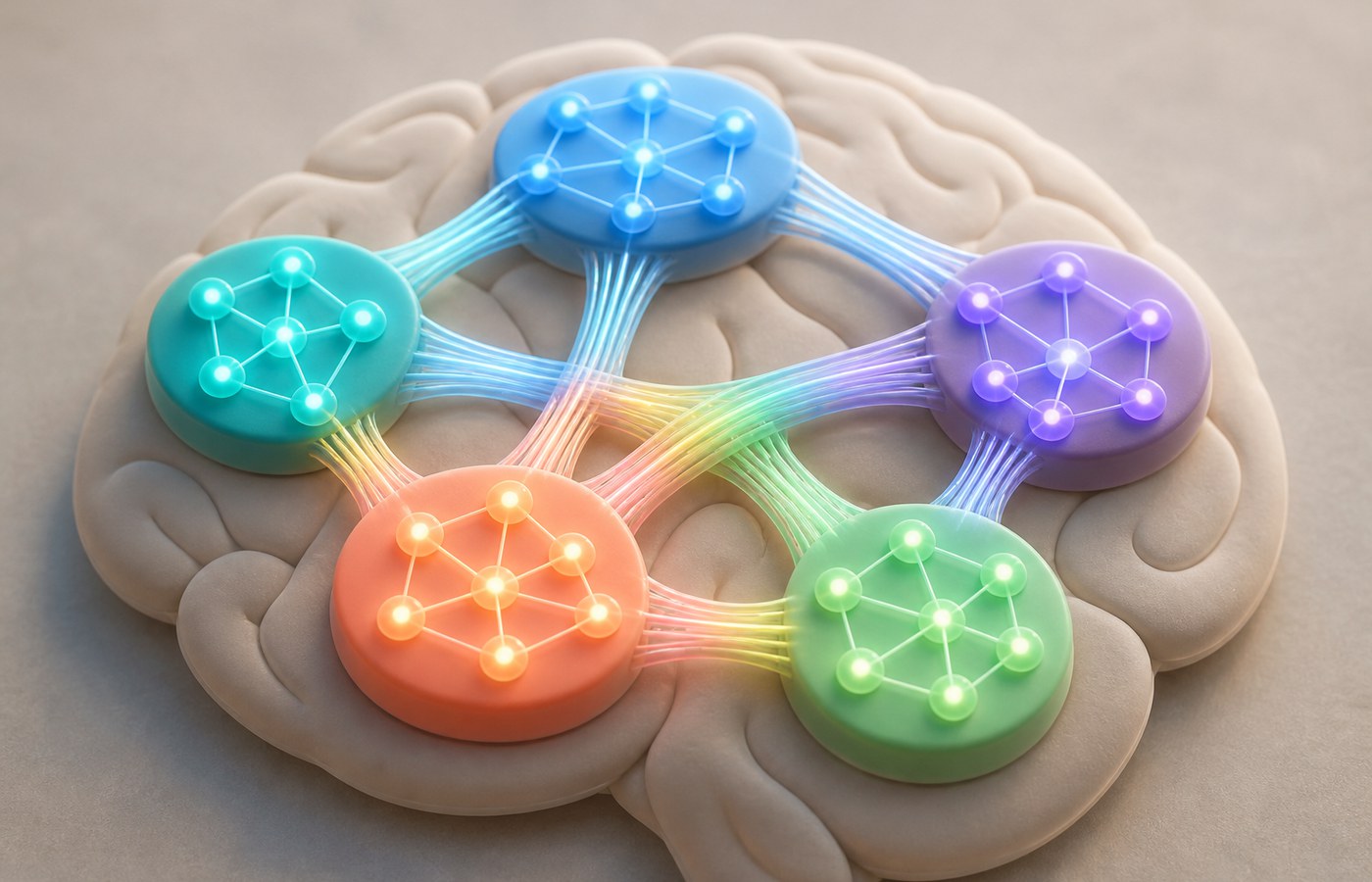
This is why a single task can involve attention, memory, vision, language, speed, and executive control. What we see as a simple action often relies on a complex network.
Areas and Connections
Some areas are more closely related to certain functions, but no important function relies on a single point. The connections between areas are fundamental.
When a task is difficult, it doesn’t always mean that a single ability is “failing.” There may be difficulty coordinating several parts of the system.
Key idea: training should adapt to the person's actual state, not the other way around.
Why Performance Changes
Brain performance is not fixed. It can change with fatigue, rest, stress, noise, medication, pain, or the difficulty of the task.
This is why two similar sessions can yield different results. An isolated measure says little; trends over time usually provide more information.
Change and Adaptation
The brain can adapt through experience. Practicing, repeating, resting, and using strategies can help consolidate learning and compensations.
This does not mean promising miraculous results. It means that training should be progressive, realistic, and tailored to each person.
What it Relates to Training
Reactiva+ allows you to practice specific functions but also to observe how they combine. A memory game may require attention; a language game may demand speed; a visual game may depend on planning.
Viewing challenges as part of a network helps better interpret the results.
- Networks: Functions work in connection.
- Variability: A worse day is not always a setback.
- Context: Sleep and fatigue matter.
- Progression: Practice should be gradual.
What You Can Train in Reactiva+
Each network in the article has its reflection in the catalog. One challenge per network, to see it in practice:
- Correct Color: attentional network: maintaining focus in the face of interference.
- Position Memory: memory network: recording and retrieving where everything was.
- Verbal Relationships: language network: meaning and relationships between concepts.
- Quick Symbolism: processing speed: deciding quickly without error.
- Rule Switching: executive control: changing criteria on the fly.
The brain does not work like separate drawers. To read, speak, or move, many areas work together at the same time.
That is why a task that seems simple can depend on attention, memory, language, and speed all at once.
No Function Depends on a Single Point
Some areas are more related to certain functions, but the connections between areas are just as important.
When something is hard, it is not always one ability that fails: it can be hard to coordinate several parts.
Why Performance Changes
The brain does not always perform the same. It changes with tiredness, rest, stress, or noise. That is why two similar days can turn out different.
Key Idea
Training must adapt to the person's real state, not the other way around.
What You Can Train in Reactiva+
- Correct Color: attention against interference.
- Position Memory: register and remember where each thing was.
- Verbal Relationships: language and meaning.
This content is educational and does not replace assessment, diagnosis or supervision by a healthcare professional.