 Reactiva
Maintaining attention is holding focus long enough to complete a task. It's not just about "putting in effort." It's a cognitive function that consumes energy.
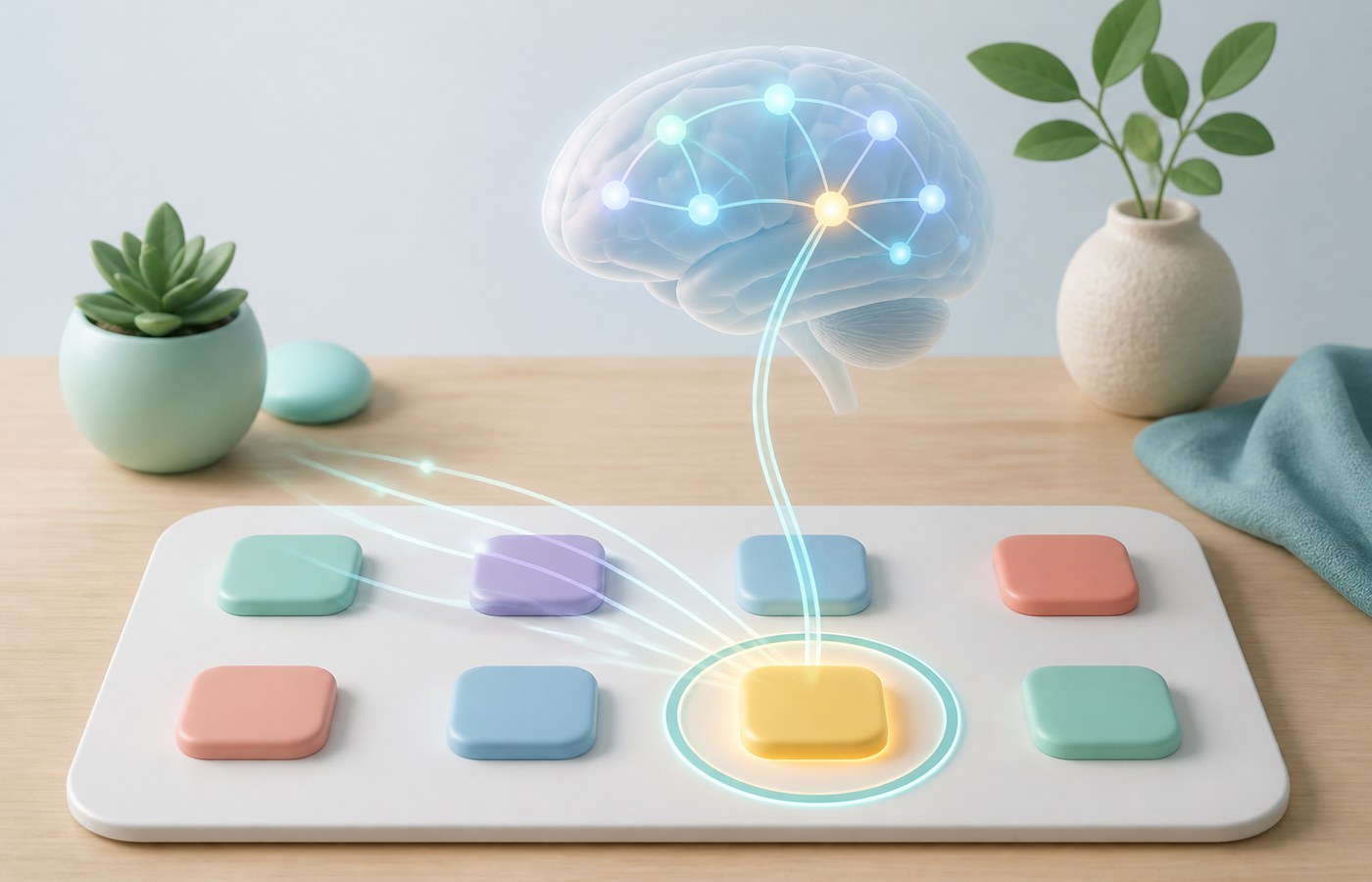
Attention allows you to follow a conversation, read a page, search for an object, drive, cook, or finish an activity without losing track.
Attention Fluctuates
Attention changes depending on sleep, fatigue, stress, motivation, noise, pain, or the difficulty of the task. That's why an activity may go well one day and be much harder another.
When attention decreases, distractions, omissions, impulsive responses, and feelings of overwhelm increase.
A poor session does not always mean regression. Sometimes it just shows that there was less attentional energy available that day.
Not All Attention is the Same
- Sustained: Maintaining focus for several minutes.
- Selective: Choosing one stimulus and ignoring distractions.
- Alternating: Switching from one rule to another without losing the goal.
- Divided: Attending to two demands at once, which is usually more demanding.
How to Train It
Attention is best trained with short, clear, and progressive tasks. If the exercise starts too high, it can lead to blockage. If it’s too easy, it doesn’t provide enough challenge.
It’s advisable to start with few distractions, large stimuli, and ample time. Afterward, you can increase the pace, add distractions, or require greater precision.
Signals to Slow Down
It’s wise to simplify if repeated errors, impulsivity, irritation, loss of thread, automatic reading without comprehension, or a clear increase in response time occur.
Slowing down is not giving up. It’s adjusting the task to continue training sustainably.
Summary
Attention is a limited and trainable capacity. It is affected by the person's overall state and the task load.
Training effectively means finding the right level of difficulty, measuring progress, and respecting signals of fatigue.
What You Can Train on Reactiva+
Challenges in the catalog that work on sustained and selective attention:
- Correct Color: maintain focus when the color and the word contradict each other.
- Read the Word: the opposite rule: read even if the color tries to distract you.
- Fleeting Color: the stimulus lasts an instant: requires prepared attention.
- Quick Symbolism: locate the match among distractors without losing focus.
- Word Search: sustained visual search for several minutes.
Maintaining attention means keeping focus long enough to finish a task. It is not just "trying hard": it is a function that uses energy.
It helps us follow a conversation, read, cook, or finish something without losing track.
Attention goes up and down
It changes with sleep, tiredness, stress, or noise. That is why a task can go well one day and be hard another.
When it goes down, distractions and impulsive responses increase.
Not all attention is the same
- Sustained: keeping focus for several minutes.
- Selective: focusing on something and ignoring the rest.
- Divided: paying attention to two things at once, the hardest.
How to train it
Better with short, clear tasks that increase slowly. If it starts too hard, it can block. It is good to start with few distractions and increase later.
Signs to slow down
If there are repeated mistakes, irritation, or losing track, it is a good time to simplify. It is not giving up, it is adjusting.
What you can train in Reactiva+
- Correct Color: keep focus when color and word do not match.
- Quick Symbols: find the match without getting distracted.
- Word Search: visual search maintained for several minutes.
This content is educational and does not replace assessment, diagnosis or supervision by a healthcare professional.