 Reactiva
The brain has two hemispheres, left and right. They work together all the time, connected by networks that facilitate the integration of language, movement, perception, memory, emotion, and attention.
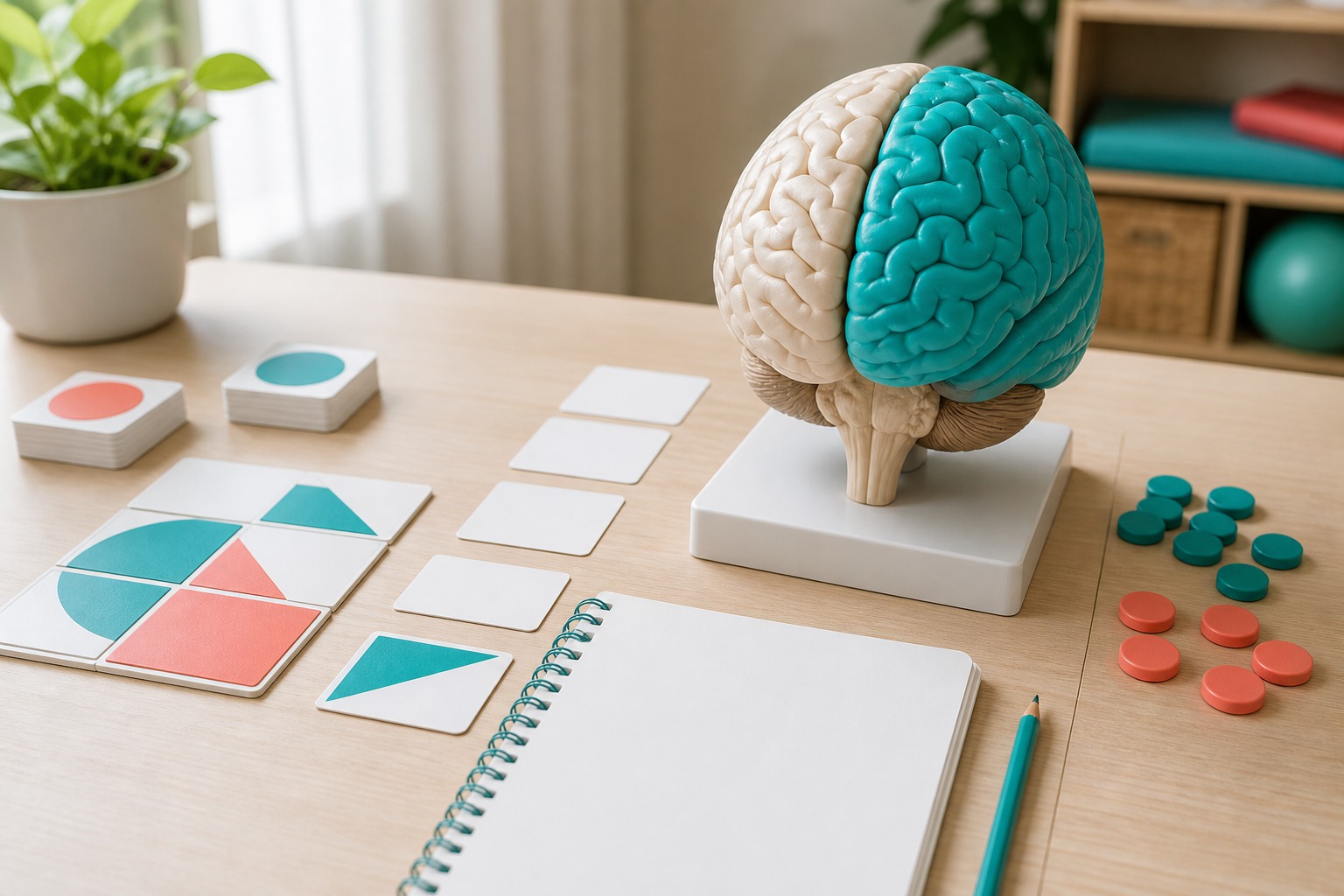
When we talk about the right hemisphere, we are not referring to an isolated area or a "simple half" of the brain. We are discussing a set of networks that often play an important role in global perception, spatial orientation, attention to the environment, non-verbal communication, and body awareness.
Key idea: the right hemisphere helps to understand space, context, tone, gestures, and many signals that do not rely solely on words.
What functions does it usually support
In general, the right hemisphere tends to participate in functions that help interpret the world as a whole, not just as separate pieces.
Spatial attention. It helps to navigate space, explore the screen, locate objects, and attend to both sides of the environment.
Global perception. It allows for the grasping of shapes, scenes, visual relationships, maps, paths, and complete configurations.
Non-verbal communication. It is involved in emotional tone, intention, irony, gestures, and facial expression.
Body awareness. It contributes to feeling the position of the body, integrating sensations, and recognizing how one moves in space.
It can also influence emotional regulation, music perception, visual memory, and the ability to interpret complex social situations.
What can happen when it is affected
An injury to the right hemisphere can produce very visible symptoms, but also silent symptoms. Not everyone presents the same issues. It depends on the affected area, the size of the injury, age, cognitive reserve, general state, and rehabilitation.
Some possible difficulties include:
- Problems attending to one side of space.
- Difficulty visually orienting.
- Clumsiness when organizing objects on a table, a screen, or in a room.
- Less sensitivity to capture gestures, tone, or intention.
- Difficulty following maps, routes, or spatial distributions.
- Changes in self-awareness of the body.
- Fatigue when there is a lot of visual or social information.
Important: just because a function is associated with the right hemisphere does not mean it always depends solely on it. The brain functions in networks. This explanation is educational, not diagnostic.
How it shows in daily life
Sometimes the difficulties of the right hemisphere are not well explained with phrases like "doesn't remember" or "doesn't understand." It can be more subtle: the person gets lost on a screen, misses a detail, becomes disorganized with a cluttered scene, or becomes overwhelmed with too many stimuli.
In daily life, it can be seen in situations like these:
- Reading a page and skipping a section.
- Not finding a button even though it is visible.
- Bumping into objects or miscalculating distances.
- Getting lost while following a route.
- Having difficulty with maps, schedules, charts, or complex screens.
- Poorly interpreting the emotional tone of a conversation.
- Becoming fatigued in places with noise, movement, or many people.
From the outside, it may seem like distraction. Internally, many times it is an issue of attention, visual integration, or cognitive load.
What can be trained
Training should be gradual. It is not about flooding the screen with stimuli or forcing the person until they fail. It is about working with clear tasks, measuring the response, and increasing difficulty only when there is stability.
Visual exploration. Searching for elements on a screen, moving from left to right, checking corners, and learning sweeping strategies.
Spatial orientation. Following routes, ordering positions, copying patterns, recognizing directions, and working with simple maps.
Selective attention. Locating a target among distractors, maintaining focus, and avoiding impulsive responses.
Social understanding. Recognizing expressions, tones, gestures, and communicative situations with visual support and context.
Difficulty can increase by reducing aids, adding distractors, incorporating more positions, or asking for more precision. But it is always advisable to respect fatigue.
How to connect it with Reactiva+
In Reactiva+, this type of training can be related to attention games, visual searching, spatial orientation, stimulus comparison, sequences, visual memory, and inhibitory control.
Some examples of useful tasks would be:
- Finding the different stimulus.
- Following a light or a route.
- Comparing two images.
- Repeating a visual sequence.
- Ordering positions in a matrix.
- Working with maps, arrows, or simple paths.
- Using autonomous mode if there is fatigue or motor difficulty.
Challenges from the catalog that fit these tasks:
- Solve: trace the route on a grid, exploring the entire space before deciding.
- Memory of positions: retain where each element was within a matrix.
- Follow spatial instructions: up, down, to the left: orientation in space using language.
- Spatial rotation: mentally rotate a figure and recognize it from another position.
- Quick symbolism: locate the symbol that matches among several distractors.
- Follow the light: with a single press, useful when there is fatigue or motor difficulty.
Practical rule: if the person gets visually lost, reduce the load. Fewer elements, larger size, more time, and clearer instruction.
Read it cautiously
Talking about the right hemisphere helps understand some difficulties, but it should not become a rigid label. Two people with similar injuries may evolve differently. And two people with similar symptoms may have different causes.
The best reading is functional:
- What is difficult in daily life.
- What happens when fatigue appears.
- What help improves performance.
- What tasks can be transferred to real situations.
- What needs to be reviewed by a professional.
The goal is not to memorize what each hemisphere does. The goal is to better understand what each person needs to train and how to do it without overload.
Important notice
This article is for informational and educational purposes. It does not replace the assessment, diagnosis, or treatment by healthcare professionals. If there are new symptoms, sudden worsening, significant changes, or medical doubts, consult with the referring professional team.
The brain has two hemispheres, left and right, that work together. The right hemisphere usually plays an important role in space, orientation, tone of voice, gestures, and body awareness.
What functions does it usually support
- Spatial attention: orienting and locating objects.
- Global perception: capturing complete scenes and maps.
- Non-verbal communication: tone, irony, gestures.
- Body awareness: feeling the position of the body.
What can happen when it is affected
- Problems attending to one side of space.
- Difficulty orienting visually.
- Less sensitivity to capture gestures or tone.
- Fatigue with a lot of visual information.
How it shows in daily life
It can show when reading a page and skipping a section, bumping into objects, or getting lost following a route. From the outside, it may seem like distraction; inside, it is a problem of attention or load.
What can be trained
- Visual exploration: searching for items on a screen.
- Spatial orientation: following routes and patterns.
- Selective attention: locating a target among distractors.
What you can train in Reactiva+
- Solve: trace a route exploring space.
- Spatial rotation: mentally rotate a figure.
- Follow the light: with a single tap, useful with fatigue.
Note
This article is informative. It does not replace a professional assessment.
This content is educational and does not replace assessment, diagnosis or supervision by a healthcare professional.